
Reading Notes: Reshaping the Global Energy Chessboard
Key Takeaways From: The Geopolitics of Renewables

Probability Note: Probabilities are purely subjective; they should be interpreted as Massif Capital’s best estimate of the probability that the author of the reviewed document might assign to his or her claim; they are not necessarily the Massif Capital expectations. Folded into the probabilities is textual sentiment analysis run via an LLM. The probabilities consistently tilt more optimistic than reality. The probabilistic framework we use is as follows:
Almost Certain (96% to 100%)
Highly Likely (76% to 95%)
Probably (56% to 75%)
About Even (46% to 55%)
Probably Not (36% to 45%)
Unlikely (36% to 5%)
Executive Summary
This book explores the geopolitical implications of a transition towards renewable energy for interstate energy relations. It investigates how the geographic and technical characteristics of renewable energy systems reshape strategic realities and policy considerations of producer, consumer, and transit countries and energy-related patterns of cooperation and conflict between them.
The volume provides a comprehensive overview of the emerging field of geopolitics of renewables through:
A novel analytical framework that links renewables' characteristics to interstate energy relations
Analysis on three levels: global energy markets, country relations, and infrastructure developments
Contributions from leading experts examining impacts on major powers and regions
Key arguments include:
Renewables will shift energy markets from oligopolistic to more competitive, eroding producer dominance
Decentralized production enables new local actors and business models
Electrification of energy systems may regionalize relations and emphasize grid management
Countries face new strategic choices between domestic production and imports
The transition creates new "winners" and "losers" in global energy
The book aims to put this novel topic on the academic and policy agenda, providing a foundation for understanding the geopolitical implications of the ongoing energy transition. It is intended for both scholars and practitioners interested in the intersection of renewable energy and international relations.
Chapter-by-Chapter Analysis
Chapter 1: The Geopolitics of Renewables - An Introduction and Expectations
Summary: This chapter introduces the topic, provides a literature review, presents an analytical framework, and outlines expectations for how renewables will reshape energy geopolitics. Key points include:
Renewables represent a game changer for interstate energy relations due to fundamentally different geographic and technical characteristics compared to fossil fuels
A framework is introduced linking renewables' characteristics to infrastructure, markets, and geopolitics
Expectations include a shift to more competitive markets, decentralized production, electrification of energy systems, and new strategic considerations for countries
Critical Supporting Evidence:
Definition of geopolitics of renewables as how geographic/technical characteristics of renewable systems shape interstate energy relations (Page: 10)
Analytical framework linking renewables' characteristics to infrastructure, markets, and geopolitics (Page: 16-17)
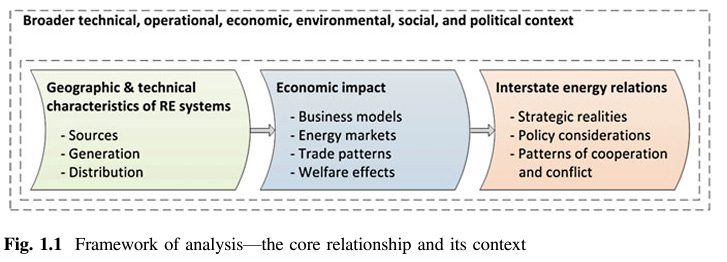
Four sets of expectations for how renewables will impact energy geopolitics (Pages: 18-24)
Chapter 2: Geopolitics of the Renewable Energy Game and Its Potential Impact upon Global Power Relations
Summary: This chapter examines how the transition to renewables may reshape global power dynamics between major energy producers and consumers. It argues that while fossil fuel exporters may lose influence, countries with renewable resources and technology could gain geopolitical leverage.
Critical Supporting Evidence:
Analysis of renewable energy potential and current utilization by region (Pages: 55-62)
Discussion of critical materials for renewable technologies and their geopolitical implications (Pages: 65-67)
Scenarios for how renewable transition could impact global power relations (Pages: 68-71)
Chapter 3: Redrawing the Geopolitical Map: International Relations and Renewable Energies
Summary: This chapter develops a quantitative model to predict geopolitical "winners" and "losers" in a renewable energy future based on countries' renewable resources, population, and human capital. It finds that many current energy importers may benefit while fossil fuel exporters could lose influence.
Critical Supporting Evidence:
Quantitative model methodology for predicting geopolitical impacts (Pages: 82-85)
Rankings of potential geopolitical winners and losers (Tables 3.1 and 3.2, Pages: 86-87)
Analysis of critical materials for renewables as a geopolitical factor (Pages: 90-93)
Chapter 4: Battling for a Shrinking Market: Oil Producers, the Renewables Revolution, and the Risk of Stranded Assets
Summary: This chapter examines the challenges facing oil-exporting countries as renewable energy grows. It argues these countries face risks of declining demand, lower prices, and stranded assets, with significant economic and political implications.
Critical Supporting Evidence:
Projections of declining oil demand due to renewables and EVs (Pages: 101-103)
Analysis of stranded asset risks for oil producers (Pages: 104-106)
Case studies of impacts on major oil exporters like Saudi Arabia (Pages: 110-114)
Chapter 5: The Geopolitical Implications of a Clean Energy Future from the Perspective of the United States
Summary: This chapter analyzes how the transition to clean energy could impact U.S. geopolitical interests and strategy. It argues the U.S. could maintain energy influence through technology leadership, but faces challenges in reshaping alliances and institutions.
Critical Supporting Evidence:
Analysis of U.S. clean energy technology advantages (Pages: 132-137)
Discussion of impacts on key U.S. relationships like Saudi Arabia (Pages: 140-144)
Recommendations for U.S. strategy in clean energy geopolitics (Pages: 156-159)
Chapter 6: The International Reverberations of Germany's Energiewende; Geoeconomics in the EU's Geo-Energy Space
Summary: This chapter examines how Germany's energy transition is impacting European energy geopolitics. It argues the Energiewende is reshaping electricity flows and market dynamics across Europe, with implications for EU integration and relations with Russia.
Critical Supporting Evidence:
Analysis of changing electricity flows in Europe due to German renewables (Pages: 172-178)
Discussion of impacts on EU energy market integration (Pages: 179-182)
Examination of implications for EU-Russia energy relations (Pages: 182-184)
Chapter 7: China and Renewables: The Priority of Economics over Geopolitics
Summary: This chapter analyzes China's approach to renewable energy, arguing that economic and environmental factors are the primary drivers rather than geopolitical considerations. However, it notes China's renewable industry could provide geopolitical influence.
Critical Supporting Evidence:
Overview of China's renewable energy policies and targets (Pages: 190-193)
Analysis of economic drivers for China's renewable push (Pages: 194-197)
Discussion of potential geopolitical impacts of China's renewable industry (Pages: 198-200)
Chapter 8: Drivers, Apparatus, and Implications of India's Renewable Energy Ambitions
Summary: This chapter examines India's renewable energy goals and policies, analyzing the domestic drivers and international implications. It argues renewables offer India energy security and development benefits, while potentially enhancing its global influence.
Critical Supporting Evidence:
Overview of India's renewable energy targets and policies (Pages: 206-210)
Analysis of domestic drivers including energy access and job creation (Pages: 211-215)
Discussion of international implications including climate diplomacy (Pages: 221-226)
Chapter 9: New Governance Challenges and Conflicts of the Energy Transition: Renewable Electricity Generation and Transmission as Contested Socio-technical Options
Summary: This chapter analyzes governance challenges arising from renewable energy integration, focusing on conflicts over electricity generation and transmission infrastructure. It examines tensions between centralized and decentralized approaches.
Critical Supporting Evidence:
Framework for analyzing renewable energy governance challenges (Pages: 234-240)
Case studies of conflicts over wind farms and transmission lines (Pages: 241-247)
Discussion of multi-level governance approaches to manage conflicts (Pages: 248-252)
Chapter 10: Connecting Visions of a Future Renewable Energy Grid
Summary: This chapter examines competing visions for future renewable-based electricity grids, contrasting centralized "supergrids" with decentralized smart grids. It analyzes the socio-technical and geopolitical implications of different grid configurations.
Critical Supporting Evidence:
Comparison of centralized and decentralized grid visions (Pages: 260-265)
Case study of North Sea offshore grid development (Pages: 266-271)
Analysis of geopolitical implications of different grid configurations (Pages: 272-274)
Chapter 11: Renewables and the Core of the Energy Union: How the Pentalateral Forum Facilitates the Energy Transition in Western Europe
Summary: This chapter analyzes how the Pentalateral Energy Forum is facilitating renewable energy integration in Western Europe. It argues this regional cooperation is reshaping European energy geopolitics and governance.
Critical Supporting Evidence:
Overview of Pentalateral Forum structure and activities (Pages: 282-287)
Analysis of Forum's role in renewable integration and market coupling (Pages: 288-293)
Discussion of implications for EU energy governance (Pages: 298-302)
Chapter 12: The Strategic Realities of the Emerging Energy Game - Conclusion and Reflection
Summary: This concluding chapter synthesizes key findings on how renewables are reshaping energy geopolitics. It reflects on emerging strategic realities for countries and implications for global energy governance.
Critical Supporting Evidence:
Summary of key geopolitical impacts of renewable energy transition (Pages: 309-315)
Analysis of strategic considerations for major powers (Pages: 316-322)
Discussion of implications for global energy governance (Pages: 323-326)
Primary Thesis
The book's overarching thesis is that the transition to renewable energy will fundamentally reshape the geopolitics of energy, creating new strategic realities, winners and losers, and patterns of cooperation and conflict between countries.
Quantitative Arguments:
Renewable energy growing faster than fossil fuels at 2.6%/year (Page: 3)
Renewables are expected to reach 15-18% of the global energy mix by 2040 (Page: 3)
The model predicts countries like Germany and Japan as geopolitical winners (Table 3.1, Page: 86) (THIS HAS CLEARLY BEEN PROVEN INCORRECT)
Qualitative Arguments:
Shift from oligopolistic to more competitive energy markets (Pages: 19-20)
Increasing decentralization of energy production (Pages: 20-21)
Electrification of energy systems regionalizing energy relations (Pages: 22-23)
New strategic choices between domestic production and imports (Pages: 23-24)
The Significance for Energy, Materials, and Industrial Industries
The transition to renewable energy has major implications for energy, materials, and industrial sectors:
Energy Industry: The shift from fossil fuels to renewables will dramatically reshape the global energy industry. Oil and gas companies face declining demand and stranded asset risks (Highly Likely). Electricity will become the dominant energy carrier, benefiting utilities able to manage variable renewables (Probable). New business models around decentralized generation and flexibility services will emerge (Highly Likely).
Materials Industry: Demand for certain materials critical for renewable technologies like rare earth elements, lithium, and cobalt will surge (Almost Certain). This could create new resource competition and supply chain risks (Probable). Recycling and substitution efforts for these materials will increase (Highly Likely).
Industrial Sector: The manufacturing of renewable energy equipment like solar panels, wind turbines, and batteries will become a key industrial sector (Almost Certain). Countries will compete for leadership in these clean energy industries as a source of jobs and exports (Highly Likely). Energy-intensive industries will need to adapt to more variable renewable electricity supplies (Probable).
Macro Economic Implications
The geopolitical shifts driven by renewable energy will have significant macroeconomic impacts:
Commodities: Oil and gas prices likely to decline long-term as demand peaks (Probable). Prices for critical materials for renewables like lithium and cobalt likely to rise (Highly Likely).
Currencies: Currencies of fossil fuel exporters likely to weaken (Probable). Currencies of countries with strong renewable industries may strengthen (About Even).
Interest Rates: Lower inflation from cheaper energy could allow lower interest rates in some countries (Probable). But transition investment needs could drive rates higher in others (About Even).
Geopolitics: Reduced importance of Middle East likely (Highly Likely). China's Belt and Road Initiative could gain influence through renewable investments (Probable). New regional cooperation around electricity grids emerging (Highly Likely).
Trade: Shifting trade patterns as fossil fuel trade declines and renewable equipment/electricity trade increases (Almost Certain). New trade tensions possible around critical materials and clean tech (Probable).